
2026-08-21

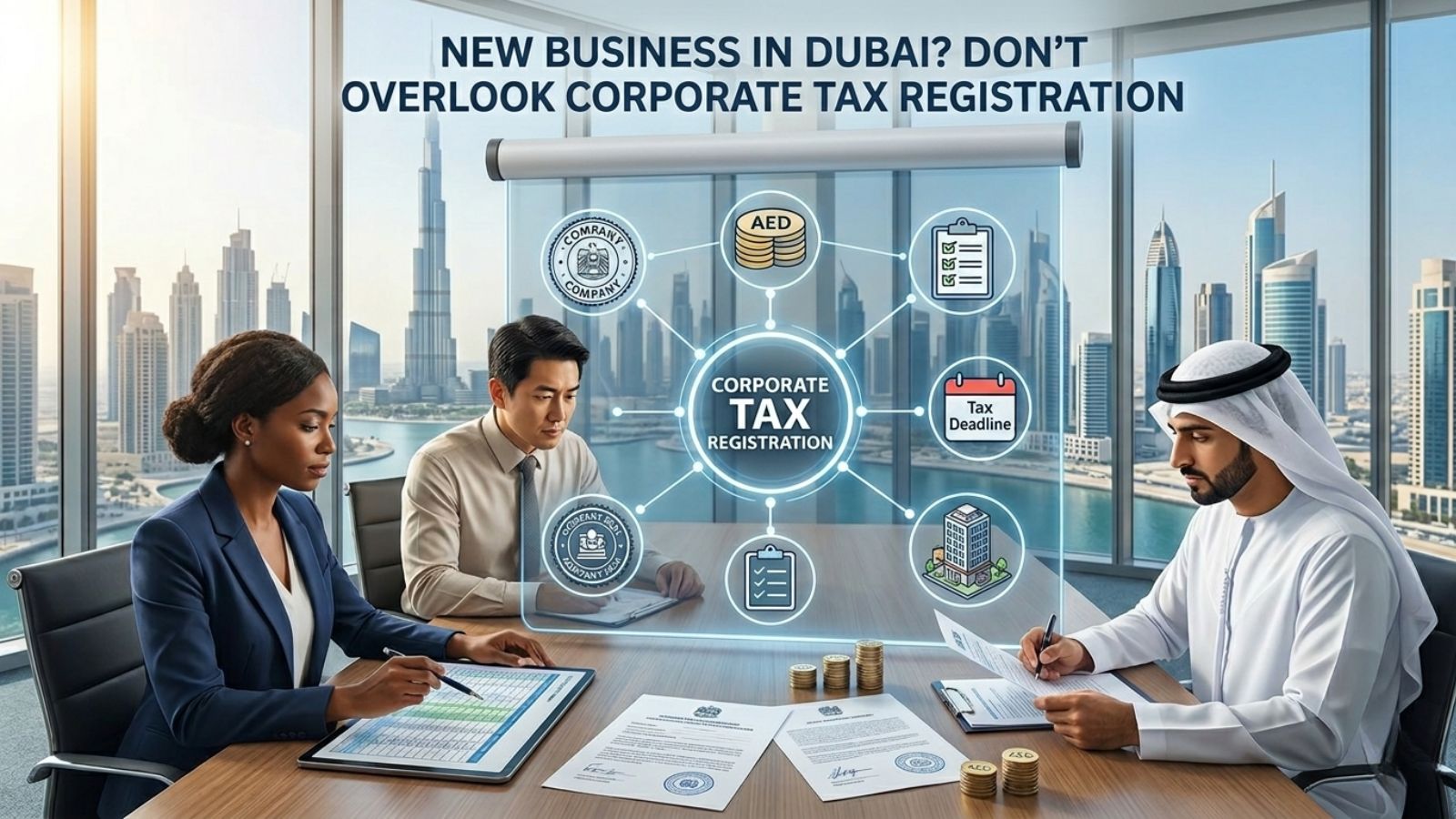
There’s no doubt about Dubai becoming one of the most vibrant destinations for business across the globe. With its strategic location, investment-friendly environment, and strong infrastructure, entrepreneurs, SMEs, as well as international corporations, look forward to setting up shop. However, along with all these advantages comes a change in regulatory perspectives.
With the introduction of Corporate Tax in 2023, the UAE has entered a new phase of financial governance. What was once considered a largely tax-free environment now requires businesses to think proactively about compliance from day one.
If you are setting up a new business in Dubai, Corporate Tax registration is not something to “figure out later.” It is an early-stage priority that directly impacts how smoothly your business operates, scales, and stays compliant.
For a deeper breakdown, you can explore our complete Corporate Tax Registration in UAE guide.
Corporate Tax in the UAE is a direct tax on the net profits of businesses. It has been introduced to align the country with global tax standards while maintaining its competitive edge.
The standard Corporate Tax rate is 9% on taxable income above the prescribed threshold, while profits below that threshold are taxed at 0%.
This regime applies broadly across:
The system is regulated and administered by the Federal Tax Authority, which oversees registration, compliance, and enforcement.
Corporate Tax registration is perceived as a legal checkbox, but it sets the foundation for your business operations in the UAE.
First, it is a mandatory requirement. Delaying or ignoring it can expose you to penalties and unnecessary compliance risks early in your business journey.
Second, being properly registered strengthens your financial credibility. Whether you are opening a bank account, dealing with investors, or undergoing audits, having your tax registration in place signals that your business is structured and compliant.
Finally, early registration ensures smoother operations as you grow. From financial reporting to funding rounds, having your tax framework in place avoids disruptions later.
Corporate Tax registration applies to a wide range of business structures in Dubai.
Mainland companies are automatically within scope and must register based on their license and operations.
Free Zone businesses are also required to register, regardless of whether they qualify for a 0% tax rate. Their position depends on whether they meet the criteria for a Qualifying Free Zone Person.
Freelancers and sole establishments are not exempt either. If they are conducting business activities in the UAE, they may fall within the Corporate Tax framework.
Foreign entities with operations, branches, or income sourced from the UAE are also required to assess their tax obligations and register where applicable.
The Corporate Tax registration process in the UAE is conducted online through the EmaraTax portal, managed by the Federal Tax Authority.
At a high level, the process begins with creating your account or logging into the portal, followed by setting up your taxable person profile. You will then be required to submit key business details, upload supporting documents, and complete the application with accurate financial and ownership information.
Once submitted, the application is reviewed by the authorities. Upon approval, your business is issued a Tax Registration Number (TRN), which serves as your official identification for Corporate Tax purposes in the UAE.
While the process is structured, accuracy at each step is critical to avoid delays or rejections.
For a detailed step-by-step guide, refer to our guide on Corporate Tax Registration in UAE or book your free consultation with one of our tax experts.
To complete your registration smoothly, you will need to prepare the following:
Free Zone businesses continue to benefit from preferential tax treatment, but only under specific conditions.
The concept of Qualifying Free Zone Person (QFZP) implies that if your business meets the criteria, you can still benefit from a 0% tax rate on qualifying income.
However, this is not automatic. You must maintain adequate substance, earn qualifying income, and comply with all regulatory requirements.
If these conditions are not met, or if your income falls outside qualifying categories, the standard 9% Corporate Tax rate may apply.
The biggest misconception is assuming that Free Zone status alone guarantees tax exemption. In reality, it is conditional and must be actively maintained.
New businesses often underestimate the importance of Corporate Tax compliance in the early stages.
Delaying registration is one of the most common mistakes, often based on the assumption that it can be handled later.
Another frequent misunderstanding is believing that Free Zone businesses are automatically exempt from tax obligations.
Errors in documentation or submitting incorrect details can also slow down the process or create compliance issues.
Finally, many businesses focus only on registration and overlook ongoing obligations such as filing, record-keeping, and reporting.
Setting up a business in Dubai? You don’t have to navigate the complexities of Corporate Tax on your own.
At The Total CFO, we support you end-to-end, ensuring your registration is accurate, timely, and aligned with your business structure. With 25+ years of expertise and a team of professional corporate tax consultants in Dubai, we bring both technical depth and practical clarity to the process.
We handle your documentation, manage your application through the EmaraTax portal, and assist you in obtaining your TRN without delays. Beyond registration, we advise you on the tax implications of operating in a Free Zone versus the mainland, helping you make informed decisions from the start.
Our support continues post-registration with compliance management, return filing, and strategic tax planning, so you are not just compliant, but also efficient in the long run.
Yes, Corporate Tax registration is mandatory for most businesses operating in Dubai. Failing to register on time can lead to penalties and compliance issues.
The standard Corporate Tax rate is 9% on taxable income above the specified threshold, while income below that threshold is taxed at 0%.
Yes, all Free Zone businesses must register for Corporate Tax, even if they qualify for a 0% tax rate under the Qualifying Free Zone Person (QFZP) criteria.
You can register online through the EmaraTax portal by submitting your business details, required documents, and completing the application process to obtain a Tax Registration Number (TRN).
Key documents include a trade license, Emirates ID or passport of owners, business contact details, and ownership structure information.
Delaying registration can result in penalties, compliance risks, and potential disruptions in business operations such as banking or investor dealings.
With over 25 years in Dubai and nearly 30 years as a Chartered and Management Accountant, Hemant has extensive experience across manufacturing, services and technology sectors. He has worked with major corporate groups including Al Tayer, Saif Al Ghurair, Dhabi, and Aditya Birla. Hemant specializes in profitability and cost management, debt restructuring, contract management, and regulatory compliance, having generated approximately USD 47.5 million in savings and profit growth. A confident public speaker and Distinguished Communicator, he lives by the quote: “You get what you reward for. If you want ants to come, you put sugar on the floor” (Charlie Munger), embodying his belief that “Profit has its own intelligence.”


With over 25 years in Dubai and nearly 30 years as a Chartered and Management Accountant, Hemant has extensive experience across manufacturing, services and technology sectors. He has worked with major corporate groups including Al Tayer, Saif Al Ghurair, Dhabi, and Aditya Birla. Hemant specializes in profitability and cost management, debt restructuring, contract management, and regulatory compliance, having generated approximately USD 47.5 million in savings and profit growth. A confident public speaker and Distinguished Communicator, he lives by the quote: “You get what you reward for. If you want ants to come, you put sugar on the floor” (Charlie Munger), embodying his belief that “Profit has its own intelligence.”

Archana Mundhra is a qualified Chartered Accountant with over 15 years of experience in multinational corporations. Her proficiency lies in financial planning and business intelligence. Her deep financial understanding and profound analytical skills empower her to assist management in realizing their objectives effectively.

Rinkle Jain is a qualified Chartered Accountant and Fellow Member of the Institute of Chartered Accountant of India. A results-driven Chartered Accountant with a distinguished career marked by proficiency in management, financial planning, and catalyzing overall company development.Demonstrates a unique blend of financial acumen, strategic insight, and leadership prowess, contributing significantly to organizational success.
test