
2026-08-21

Choosing how to set up your business in the UAE is no longer just a strategic choice, but a tax decision.
While Mainland, Free Zone and Offshore companies may appear alike at first sight – especially when you concentrate on speed and cost, the introduction of Corporate Tax in 2023 changes things completely. Depending on how your business is structured, you may be exposed to vastly different tax implications.
Given the tighter regulatory nature of UAE laws, long-held assumptions no longer apply. A Free Zone license does not automatically mean 0% tax. An Offshore entity does not always mean no tax exposure. And Mainland businesses cannot afford to delay compliance without consequences.
In this blog, we’ll be breaking down how Corporate Tax registration and obligations differ across each structure, and how you can achieve compliance with the right approach.
Corporate Tax is a direct tax levied on business profits. Introduced as part of the UAE’s move toward a more globally aligned financial system, it applies to most businesses operating in the UAE, with some important distinctions.
The regime came into effect for financial years starting on or after 1 June 2023. It sets a standard rate of 9% on taxable profits above the prescribed threshold, while allowing a 0% rate on qualifying income, particularly relevant for eligible Free Zone businesses that meet specific conditions.
In terms of scope, Corporate Tax applies broadly across both mainland and Free Zone entities. Mainland businesses are generally subject to the standard rate, whereas Free Zone companies can still access preferential treatment — only if they comply with defined criteria around income, substance, and regulatory requirements.
Mainland businesses are licensed under UAE government authorities and can operate freely across the UAE market as well as internationally. They are often the preferred choice for businesses targeting local customers, government contracts, or retail operations within the country.
Free Zones are designated economic areas created to attract foreign investment through incentives such as full ownership, simplified setup, and historically favorable tax treatment. Each Free Zone typically caters to specific industries, offering tailored infrastructure and regulatory support.
The offshore companies are mainly formed for the purpose of conducting business overseas or managing assets or structuring. They do not necessarily have to be physically located in the UAE, but they are restricted from doing any business in the local UAE market.
The way Corporate Tax applies varies significantly across these structures.
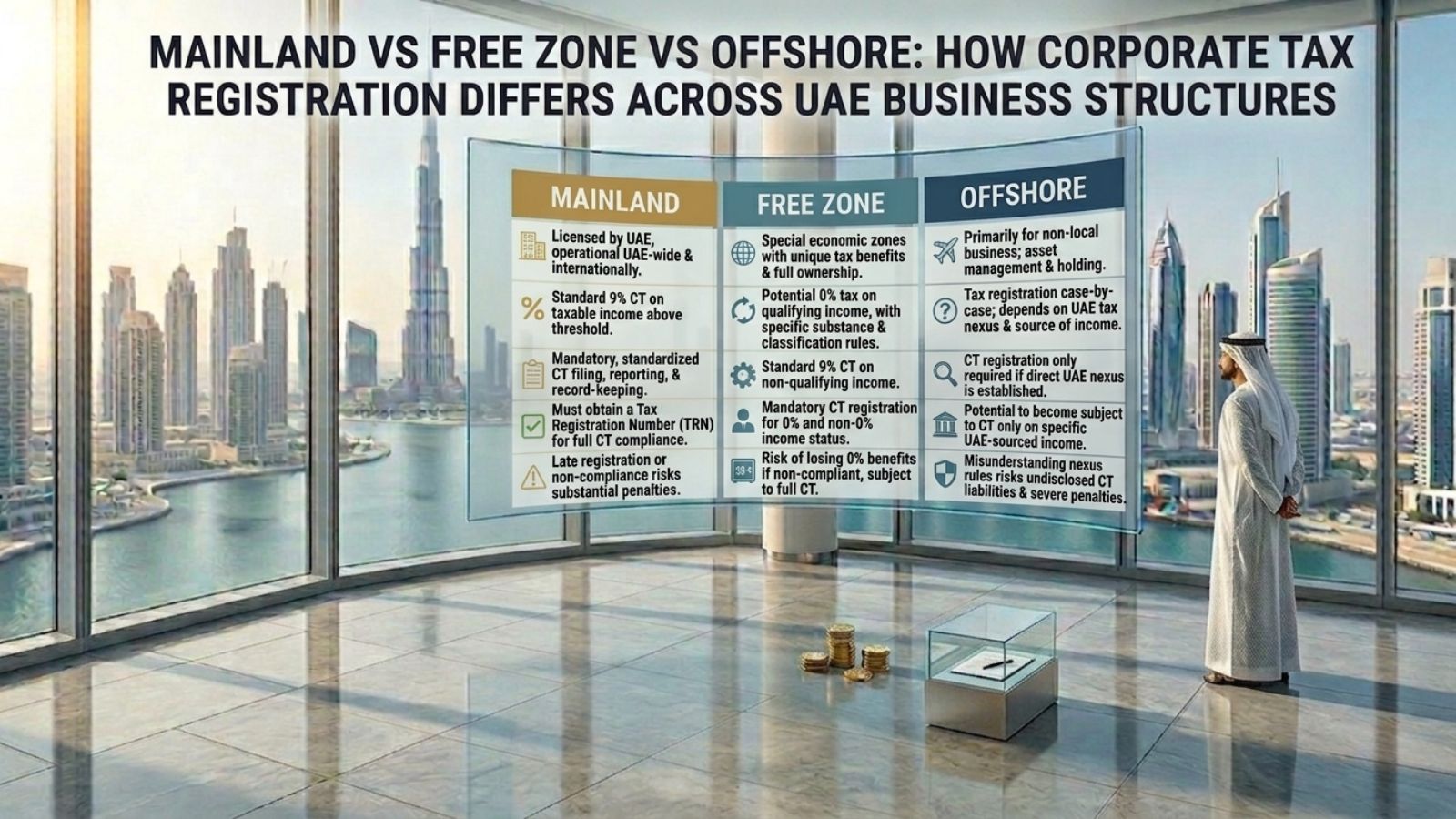
Mainland businesses are fully subject to Corporate Tax at 9% on taxable income above the threshold. There are no special exemptions tied to location.
Free Zone businesses operate under a dual framework. They can benefit from a 0% tax rate on qualifying income if they meet the criteria of a Qualifying Free Zone Person. However, non-qualifying income is taxed at 9%.
Offshore businesses fall into a more nuanced category. Their tax liability depends on whether they have a UAE nexus, such as generating UAE-sourced income or having a taxable presence. In such cases, Corporate Tax obligations may apply.
The key takeaway is simple. Your structure directly determines how your income is taxed.
Corporate Tax registration is mandatory for all businesses that fall within the scope of the law, regardless of structure.
The process is completed online through the EmaraTax portal, where businesses submit their details and supporting documents to obtain a Tax Registration Number (TRN).
Depending on your business’ location, Corporate Tax can apply to you in different ways:
| Mainland business | Free Zone business | Offshore business |
| Mainland businesses must register and comply with standard Corporate Tax filing, reporting, and record-keeping requirements without exception. | Free Zone businesses must also register, even if they qualify for a 0% tax rate. In addition to standard compliance, they must continuously meet the criteria for Qualifying Free Zone Person status, including maintaining substance and correctly classifying income. | Offshore businesses face a different kind of complexity. Registration is required only if a UAE tax nexus exists, but determining this often involves careful assessment of operations, income sources, and residency status. Compliance is typically handled on a case-by-case basis. |
For a complete step-by-step registration process, refer to our guide on Corporate Tax Registration.
For Mainland businesses, all taxable income is factored in under the standard Corporate Tax framework.
Free Zone businesses must clearly distinguish between qualifying and non-qualifying income. For example, income from other Free Zone entities or international markets may qualify for 0%, while certain mainland transactions may attract 9%.
Offshore entities are primarily assessed based on UAE-sourced income. If their income is generated outside the UAE without a local nexus, Corporate Tax may not apply. However, once UAE linkage is established, tax obligations come into play.
In practical terms, two businesses with similar revenues can face entirely different tax outcomes based on structure and income classification.
When it comes to Corporate Tax in the UAE, the risks have a direct impact on financial and operational aspects of your business, regardless of whether you are a Mainland, Free Zone, or Offshore business.
One of the most immediate impacts is penalties for late registration or non-compliance. Missing deadlines set by the Federal Tax Authority can result in fines that add up quickly, especially if delays continue across multiple obligations.
For Free Zone businesses, the stakes can be even higher. Failing to meet Qualifying Free Zone Person (QFZP) criteria or misclassifying income can lead to the loss of the 0% tax benefit, pushing your business into the standard 9% Corporate Tax bracket.
Offshore entities face a different risk. Incorrectly assuming no tax exposure without properly assessing UAE nexus can result in unreported liabilities, which may trigger scrutiny, penalties, or retrospective compliance issues.
Across all structures, inaccurate filings, poor documentation, or weak record-keeping can lead to audits, delays, and reputational damage, especially when dealing with banks, investors, or regulatory authorities.
For Corporate tax, your obligations depend entirely on your business structure, how your income is generated, and how well you manage compliance.
This is where professional insight and guidance can help you. At The Total CFO, we work with Mainland, Free Zone, and Offshore businesses to bring clarity and control to Corporate Tax. With 25+ years of expertise and a team of leading corporate tax consultants in Dubai, we help you navigate structure-specific requirements, from registration to long-term compliance.
We believe in comprehensive tax support, whether it’s about handling your Corporate Tax registration, ensuring accurate documentation, and securing your TRN without delays. For Free Zone businesses, we assess your eligibility as a Qualifying Free Zone Person and guide you on maintaining 0% tax benefits. For Offshore entities, we evaluate your UAE tax nexus and residency position to ensure you are neither overexposed nor non-compliant.
Ready to simplify your Corporate Tax journey? We’ll guide you. Talk to one of our tax experts to get advanced compliance support.
Yes, Corporate Tax registration is mandatory for all businesses that fall within the scope of UAE Corporate Tax law, regardless of whether they are Mainland or Free Zone entities. Offshore businesses are required to register only if they have a UAE tax nexus.
No, Free Zone companies can benefit from a 0% Corporate Tax rate only if they qualify as a Qualifying Free Zone Person (QFZP) and meet specific conditions related to income, substance, and compliance. Non-qualifying income is taxed at 9%.
Mainland companies are subject to Corporate Tax at a standard rate of 9% on taxable profits above the prescribed threshold, with no location-based exemptions.
Not always. Offshore companies may be subject to Corporate Tax if they have a UAE nexus, such as earning UAE-sourced income or having a taxable presence in the country.
Businesses must register through the EmaraTax portal by submitting the required details and documents to obtain a Tax Registration Number (TRN).
Non-compliance can result in penalties, loss of tax benefits (especially for Free Zone businesses), audits, reputational damage, and potential legal complications.
With over 25 years in Dubai and nearly 30 years as a Chartered and Management Accountant, Hemant has extensive experience across manufacturing, services and technology sectors. He has worked with major corporate groups including Al Tayer, Saif Al Ghurair, Dhabi, and Aditya Birla. Hemant specializes in profitability and cost management, debt restructuring, contract management, and regulatory compliance, having generated approximately USD 47.5 million in savings and profit growth. A confident public speaker and Distinguished Communicator, he lives by the quote: “You get what you reward for. If you want ants to come, you put sugar on the floor” (Charlie Munger), embodying his belief that “Profit has its own intelligence.”


With over 25 years in Dubai and nearly 30 years as a Chartered and Management Accountant, Hemant has extensive experience across manufacturing, services and technology sectors. He has worked with major corporate groups including Al Tayer, Saif Al Ghurair, Dhabi, and Aditya Birla. Hemant specializes in profitability and cost management, debt restructuring, contract management, and regulatory compliance, having generated approximately USD 47.5 million in savings and profit growth. A confident public speaker and Distinguished Communicator, he lives by the quote: “You get what you reward for. If you want ants to come, you put sugar on the floor” (Charlie Munger), embodying his belief that “Profit has its own intelligence.”

Archana Mundhra is a qualified Chartered Accountant with over 15 years of experience in multinational corporations. Her proficiency lies in financial planning and business intelligence. Her deep financial understanding and profound analytical skills empower her to assist management in realizing their objectives effectively.

Rinkle Jain is a qualified Chartered Accountant and Fellow Member of the Institute of Chartered Accountant of India. A results-driven Chartered Accountant with a distinguished career marked by proficiency in management, financial planning, and catalyzing overall company development.Demonstrates a unique blend of financial acumen, strategic insight, and leadership prowess, contributing significantly to organizational success.
test