2026-09-09

UAE Value Added Tax · Legislative Update
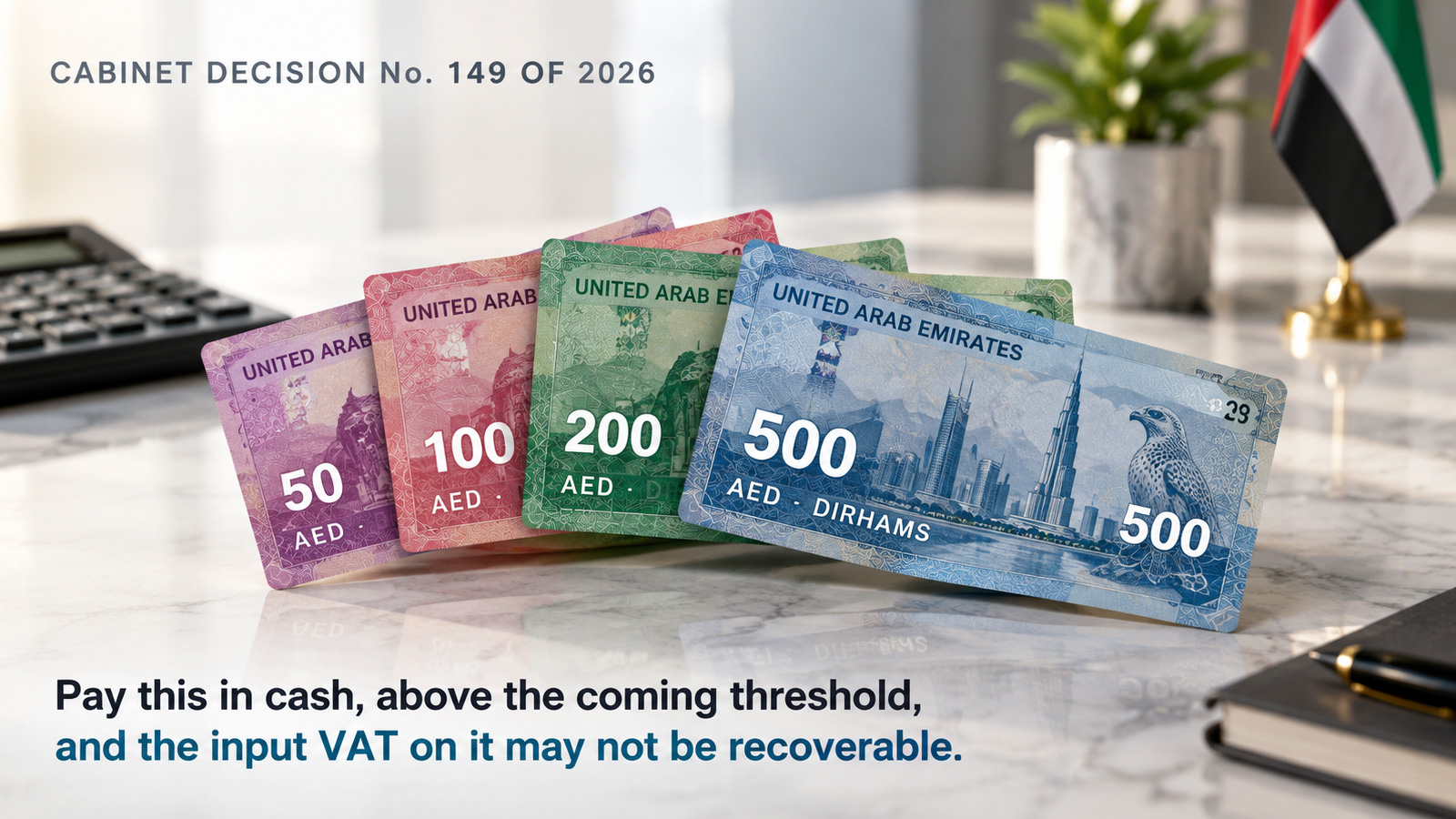
Cabinet Decision No. 149 of 2026 has amended the VAT Executive Regulation. Most of it applies from 1 October 2026. Among the changes sits a quiet but consequential new rule: settle a large invoice in cash, and the input tax on it may simply be gone. Read beside the Know Your Supplier reform that starts on the same date, its purpose is unmistakable.
Hemant Mundhra, The Total CFO
The Cabinet has added a new clause to Article 54 of the Executive Regulation. Where the consideration for a supply exceeds a value to be set by the Minister, and that consideration is paid, or intended to be paid, in cash, the input tax on that supply may not be recovered. The threshold itself, and the controls that surround it, will follow in a Ministerial Decision.
Read on its own, this looks like a housekeeping rule about how one settles invoices. Read alongside what the FTA introduced immediately before it, the intent becomes clear. This is not about tidiness. It is about traceability.
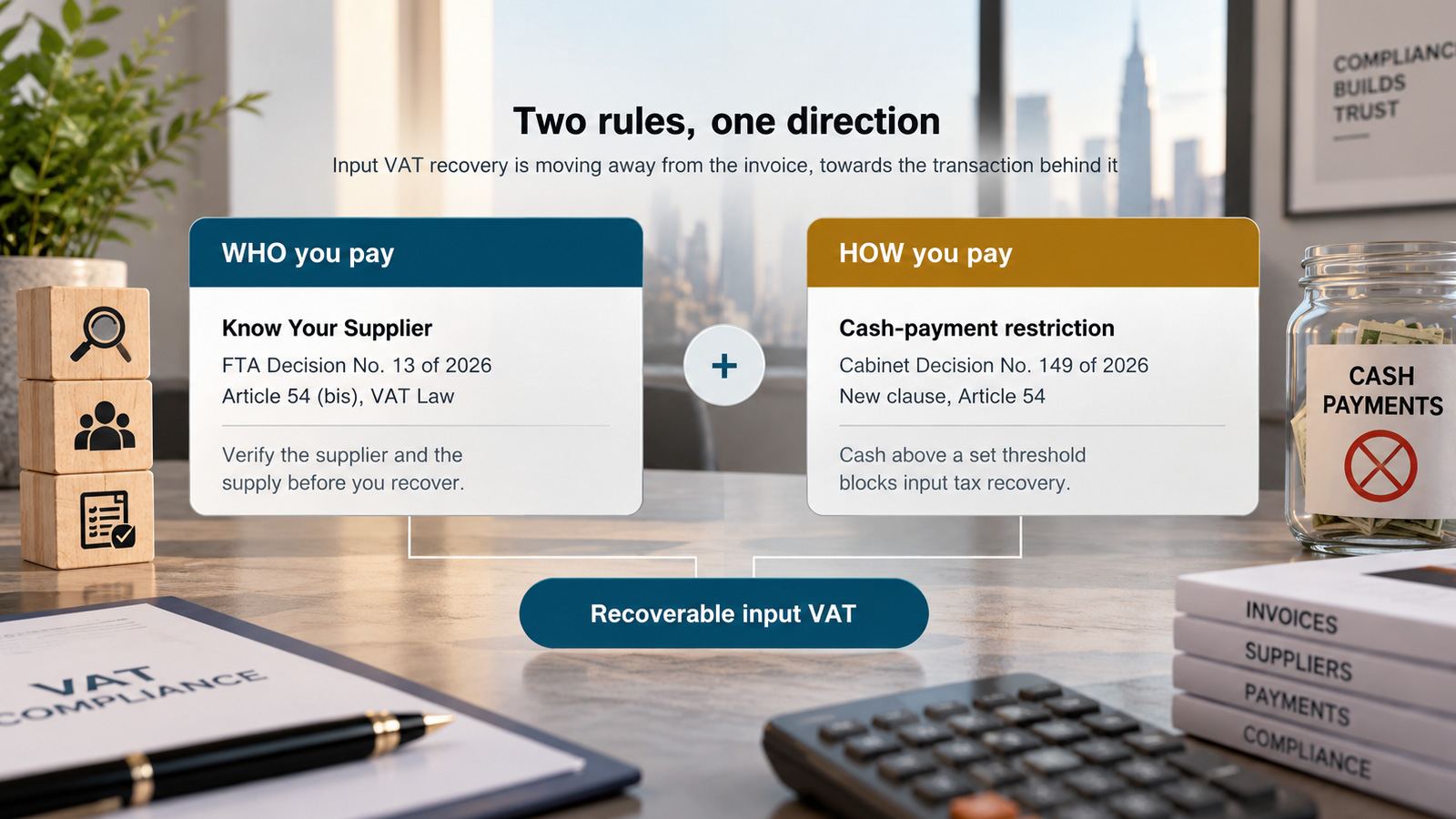
From the same 1 October 2026 date, FTA Decision No. 13 of 2026 requires every registered business to verify its supplier, and the supply itself, before recovering input VAT. That obligation sits under Article 54 (bis) of the VAT Law. It was the shift many of us described at the time as the move from Know Your Customer to Know Your Supplier: recovery began to turn on who one is dealing with, not merely on whether the tax invoice was in order.
The cash-payment restriction completes the pair. Recovery will now turn not only on who one pays, but on how one pays. Both rules pull in the same direction. Each moves the recovery test away from the paperwork on the desk and towards the substance and traceability of the transaction behind it. A flawless invoice settled in cash to an unverified supplier is precisely the fact pattern these two provisions are built to catch.
The practical message follows from that. A business that routinely settles significant amounts in cash should be examining those flows now, before the threshold is published, rather than waiting to discover which of its purchases fall inside the restriction. Cash that was merely inconvenient is becoming cash that is expensive.
The cash rule is the headline, but it is not the whole Decision. Four further changes are worth putting on the radar.
Where the elements of a transaction are economically linked and cannot realistically be separated, they are now treated as a single composite supply and taxed according to their principal component. Any business selling bundled offerings, particularly where the components would otherwise carry different VAT liabilities, should revisit how those bundles are described and taxed.
Input tax on goods or services provided to staff is available where the provision is required under the applicable labour legislation, or arises from a contractual obligation or a documented company policy. Accommodation is treated separately, and some conditions are left to further FTA guidance, so employee-benefit policies are worth reading against the new wording rather than assumed to be unaffected.
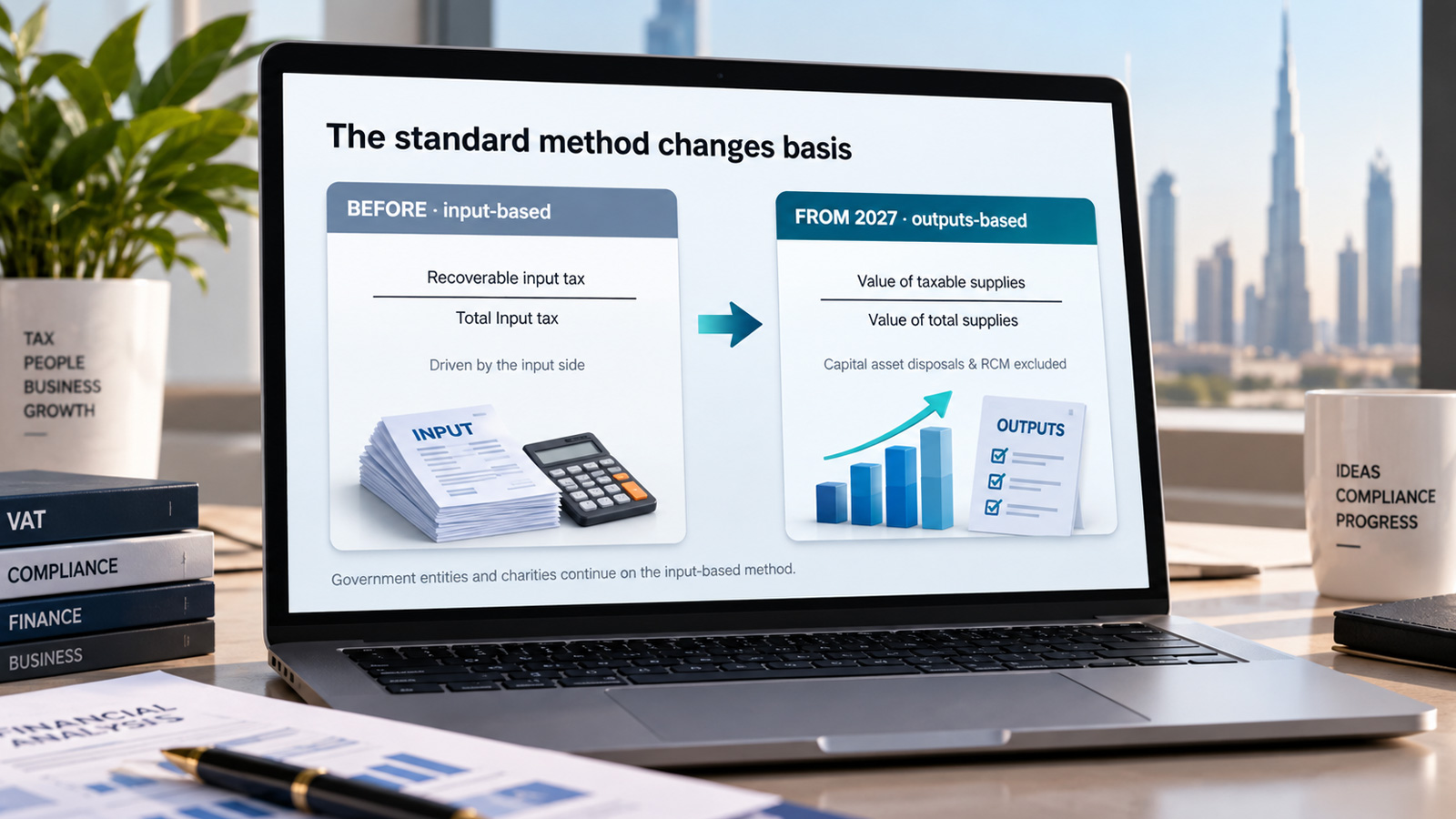
The standard apportionment method changes. Instead of working from the input side, the recoverable proportion is calculated from outputs: the value of taxable supplies as a proportion of the value of total supplies, with capital asset disposals and reverse-charge amounts excluded from the ratio. Government entities and charities continue on the input-based method. For many businesses that have struggled with the existing input-based calculation, this is a welcome simplification.
The Decision also tidies up the treatment of non-resident suppliers, healthcare-related goods, and the Capital Asset Scheme. These are refinements rather than reversals, but they remove some longstanding uncertainty.
The dates matter, because they are not all the same. The bulk of the Decision, including the cash-payment restriction, applies from 1 October 2026. The partial-exemption change is given a longer runway: it takes effect from the first tax year commencing after 1 October 2027. Planning should treat the two as separate horizons.

01. Map your cash settlements.
Identify where purchases above any plausible threshold are paid in cash, and start moving them to traceable means.
02. Read the two rules together.
Supplier verification and cash restriction are one control system; a gap in either exposes the same input tax.
03. Revisit bundled pricing.
Check composite offerings where components carry different VAT treatment.
04. Review employee-benefit policies.
Confirm that recovery rests on a labour-law requirement, a contract, or a documented policy.
05. Diarise the partial-exemption change.
It is later, but the shift in method rewards early modelling.
If it would help to work through what these amendments mean for your business, do get in touch.
Hemant Mundhra | The Total CFO Management Consultancy LLC
[email protected] · www.TheTotalCFO.com · +971 50 655 7059
This article is general information on a recent legislative change and is not tax advice. It does not create an advisory relationship. Specific positions should be confirmed against the published Decision and any subsequent Ministerial Decision.
With over 25 years in Dubai and nearly 30 years as a Chartered and Management Accountant, Hemant has extensive experience across manufacturing, services and technology sectors. He has worked with major corporate groups including Al Tayer, Saif Al Ghurair, Dhabi, and Aditya Birla. Hemant specializes in profitability and cost management, debt restructuring, contract management, and regulatory compliance, having generated approximately USD 47.5 million in savings and profit growth. A confident public speaker and Distinguished Communicator, he lives by the quote: “You get what you reward for. If you want ants to come, you put sugar on the floor” (Charlie Munger), embodying his belief that “Profit has its own intelligence.”


With over 25 years in Dubai and nearly 30 years as a Chartered and Management Accountant, Hemant has extensive experience across manufacturing, services and technology sectors. He has worked with major corporate groups including Al Tayer, Saif Al Ghurair, Dhabi, and Aditya Birla. Hemant specializes in profitability and cost management, debt restructuring, contract management, and regulatory compliance, having generated approximately USD 47.5 million in savings and profit growth. A confident public speaker and Distinguished Communicator, he lives by the quote: “You get what you reward for. If you want ants to come, you put sugar on the floor” (Charlie Munger), embodying his belief that “Profit has its own intelligence.”

Archana Mundhra is a qualified Chartered Accountant with over 15 years of experience in multinational corporations. Her proficiency lies in financial planning and business intelligence. Her deep financial understanding and profound analytical skills empower her to assist management in realizing their objectives effectively.

Rinkle Jain is a qualified Chartered Accountant and Fellow Member of the Institute of Chartered Accountant of India. A results-driven Chartered Accountant with a distinguished career marked by proficiency in management, financial planning, and catalyzing overall company development.Demonstrates a unique blend of financial acumen, strategic insight, and leadership prowess, contributing significantly to organizational success.
test