2026-03-20

Corporate Governance Vs. Business Governance: What’s the Difference?
2026-02-12
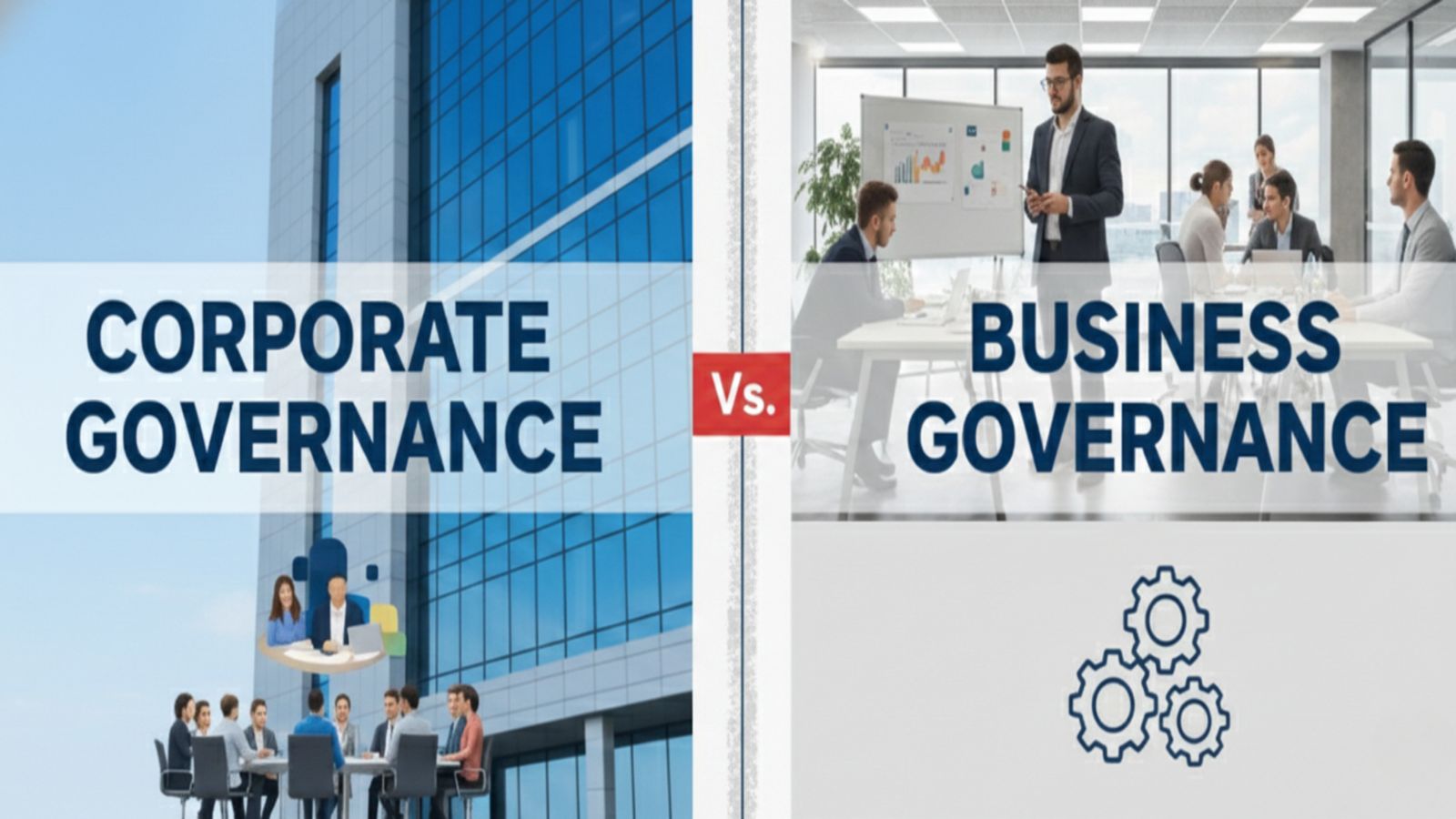
Corporate Governance is the governance of a corporation, specifically addressing the relationship between the board of directors, management, shareholders and other stakeholders. It is focused on ensuring accountability, transparency, and proper oversight of the company’s activities, often involving regulatory and legal compliance.
Corporate governance is basically about how a company is run and controlled. It’s the system that makes sure the company sets the right goals and makes decisions responsibly; while following laws, meeting market expectations, and considering its impact on society.
It can be understood as a framework that defines how a company should operate and behave. It connects the key people involved in a business, such as Shareholders (the owners or investors), The board of directors (the group overseeing big decisions), Top management (the executives running daily operations) and Employees.
Sometimes it also includes customers and the community where the company operates.
The board of directors plays a major role in corporate governance because they approve important decisions and guide the company’s direction. So when people talk about corporate governance, they’re usually talking about: what the board is responsible for, what decisions they make or who sits on the board.
Good corporate governance helps leaders make ethical, smart, and responsible decisions. And making good decisions consistently is what builds a strong, trustworthy, and long-lasting business.
Business governance refers to the rules, standards, and processes that a business uses to direct and control its operations. Governance therefore describes the relationship between the company’s management (that being the executive team of the company) & its Board of Directors, shareholders & all other stakeholder groups.
The governance of a business also establishes the business strategies of the organization and how the business will reach the objectives and how all of the business’s activities will be controlled. Good governance establishes that companies will conduct business in a fair, transparent and accountable manner.
As corporations are the backbone of our society, governance is a key area of concern for all companies; this is true regardless of the size or revenue of the organization. The most common reasons for companies of any size to implement an effective governance framework are:
Conversely, through using sound governance principles, an organization is able to develop and maintain a long-term perspective for providing assurance for that organization’s strategies and operations to sustain growth and success over time, while also considering environmental and social issues in decision-making processes in order to achieve the desired level of long-term growth and success of the organization.
Here are the differences between Corporate Governance and Business Governance:
| 1. | Scope | Corporate governance is mainly used for corporations (especially large or publicly listed companies). | Business governance applies to any business, big or small. |
2. | Focus | Corporate governance focuses heavily on the board of directors and shareholders. | Business governance focuses on overall management and decision-making in the business. |
3. | Legal Structure | Corporate governance is Often guided by strict legal and regulatory requirements. | Business governance may or may not have formal legal frameworks, especially in small businesses. |
4. | Stakeholders Involved | Corporate governance has a strong emphasis on shareholders, board members, and compliance bodies. | Business governance can include owners, managers, employees, and daily operations. |
5. | Formality | Corporate governance is more structured and documented. | Business governance can be formal or informal, depending on the size of the business. |
In simple terms, corporate governance is more formal and specifically meant for corporations, especially larger ones with boards and shareholders. Business governance, on the other hand, is a broader idea, it simply refers to how any business is managed and run
The Total CFO provides Corporate governance advisory UAE to organisations who are growing regionally and internationally, facing regulatory pressure from authorities or strengthening internal controls to align with UAE commercial companies law and global governance standards.
Ultimately, strong governance frameworks enable businesses to operate responsibly, manage risk effectively, and sustain long-term growth in an increasingly complex and competitive environment. When a company is well-governed, it makes better decisions, stays organised, and gains a stronger position in the market.
Corporate governance refers to the framework of rules, processes, and relationships through which a corporation is directed and controlled. It defines the roles and responsibilities of the board of directors, management, shareholders, and other stakeholders to ensure accountability, transparency, and regulatory compliance.
Corporate governance works by establishing clear structures for decision-making and oversight. The board of directors provides strategic direction and supervision, while management handles daily operations. This system ensures the company operates responsibly, complies with laws, and aligns with stakeholder expectations.
Corporate governance is typically associated with corporations, especially large or publicly listed companies, and focuses heavily on board oversight and shareholder interests.
Business governance is broader and applies to businesses of any size, focusing on overall management, operational control, and internal decision-making processes.
Business governance improves productivity, enhances decision-making clarity, strengthens risk management, attracts investors, and builds credibility. Regardless of size, a well-governed organization is better positioned for sustainable growth and long-term success.
Organizations in the UAE typically require corporate governance advisory when they are expanding regionally or internationally, preparing for IPOs, attracting foreign investment, facing regulatory requirements from authorities, or strengthening internal controls to align with UAE Commercial Companies Law and global governance standards.
Strong governance frameworks promote responsible leadership, effective risk management, transparency, and strategic clarity. This enables businesses to make better decisions, maintain stakeholder trust, and remain competitive in an increasingly complex market environment.
With over 25 years in Dubai and nearly 30 years as a Chartered and Management Accountant, Hemant has extensive experience across manufacturing, services and technology sectors. He has worked with major corporate groups including Al Tayer, Saif Al Ghurair, Dhabi, and Aditya Birla. Hemant specializes in profitability and cost management, debt restructuring, contract management, and regulatory compliance, having generated approximately USD 47.5 million in savings and profit growth. A confident public speaker and Distinguished Communicator, he lives by the quote: “You get what you reward for. If you want ants to come, you put sugar on the floor” (Charlie Munger), embodying his belief that “Profit has its own intelligence.”


With over 25 years in Dubai and nearly 30 years as a Chartered and Management Accountant, Hemant has extensive experience across manufacturing, services and technology sectors. He has worked with major corporate groups including Al Tayer, Saif Al Ghurair, Dhabi, and Aditya Birla. Hemant specializes in profitability and cost management, debt restructuring, contract management, and regulatory compliance, having generated approximately USD 47.5 million in savings and profit growth. A confident public speaker and Distinguished Communicator, he lives by the quote: “You get what you reward for. If you want ants to come, you put sugar on the floor” (Charlie Munger), embodying his belief that “Profit has its own intelligence.”

Archana Mundhra is a qualified Chartered Accountant with over 15 years of experience in multinational corporations. Her proficiency lies in financial planning and business intelligence. Her deep financial understanding and profound analytical skills empower her to assist management in realizing their objectives effectively.

Rinkle Jain is a qualified Chartered Accountant and Fellow Member of the Institute of Chartered Accountant of India. A results-driven Chartered Accountant with a distinguished career marked by proficiency in management, financial planning, and catalyzing overall company development.Demonstrates a unique blend of financial acumen, strategic insight, and leadership prowess, contributing significantly to organizational success.
test