2026-09-09

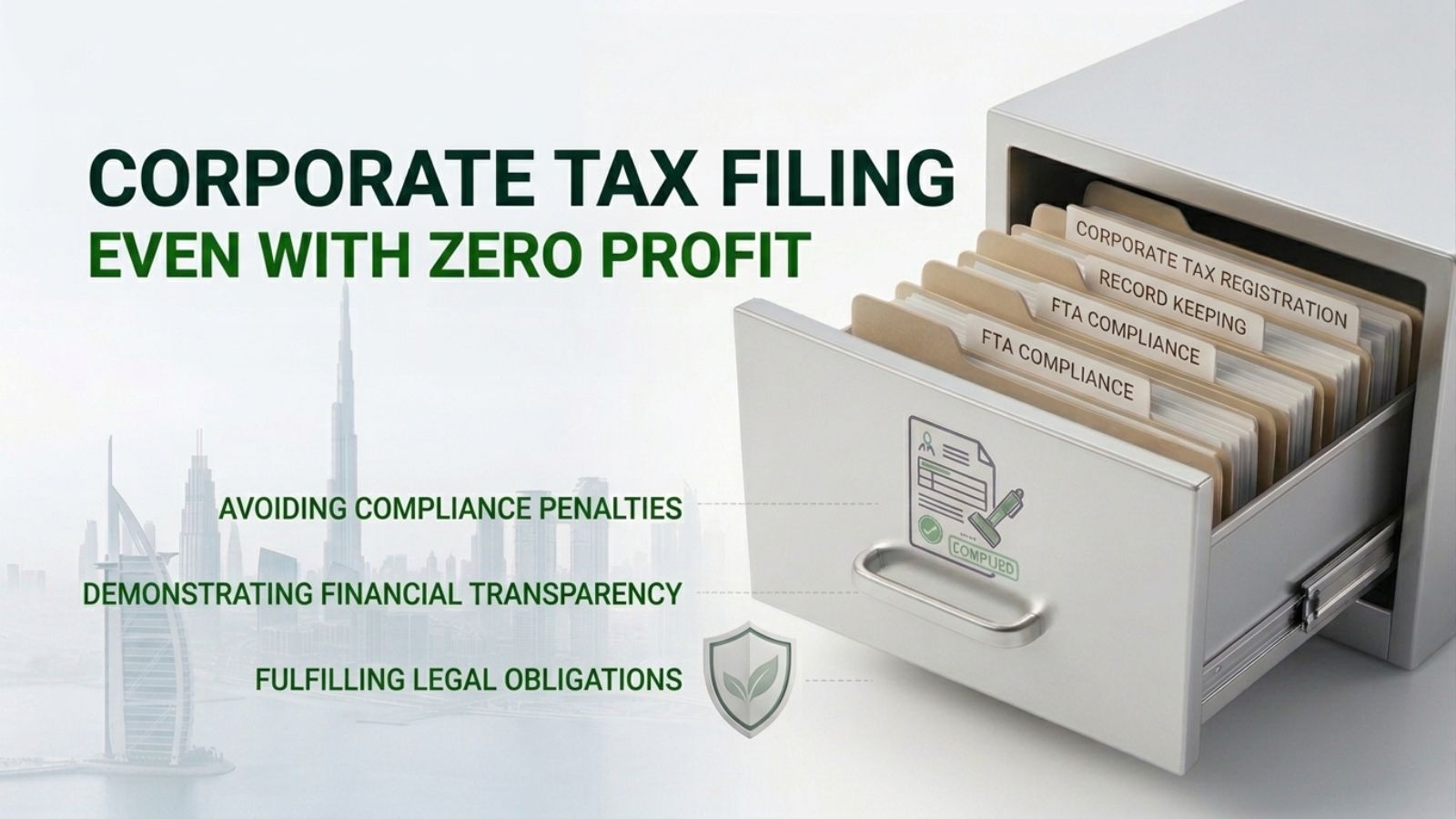
“My business didn’t make a profit this year, so do I still need to file a Corporate Tax Return?”
This has to be one of the frequently asked questions among the UAE business owners when it comes to their Corporate Tax obligations.
For many startups, SMEs, and newly established firms, it might look like a year without profit means filing obligations isn’t necessary.
However, under the UAE Corporate Tax system, earning profits or incurring losses doesn’t affect your obligations to pay taxes and file relevant documentation. A company may not earn a single dirham in profits, or even incur losses, and yet be obliged to file their Corporate Tax Return to the FTA.
Misunderstanding this distinction can lead to missed filing deadlines, unnecessary penalties, and avoidable compliance issues. In this guide, we’ll dive into cases when a company has no profits and must still file their Corporate Tax documents to ensure compliance with the UAE Corporate Tax regulations.
Making no profit doesn’t automatically mean that a business is not required to submit the Corporate Tax Return form. If a business is registered for Corporate Tax, the expectation would generally be for the company to fulfill its obligations despite not paying tax.
The misconception is based on the belief that since there is no profit, there is no tax and hence no requirement to file.
It may be possible that the business has made sales but had high costs leading to insignificant or zero profits.
It is possible that a business has some income but it has been offset by allowable deductions or losses carried forward.
This is a different concept and should never be confused with failure to pay tax.
This difference must be clear to ensure that filing obligations continue despite the absence of Corporate Tax liability.
Why Filing Obligations Exist Even When No Tax Is Payable
Business owners often find themselves asking why they must file a tax return when there is no tax liability owed. This is because the function of the Corporate Tax system needs to be understood properly.
Through a Corporate Tax Return, the FTA is able to review the financial situation of the business to see whether any tax liability has arisen. In cases where a return is not filed, the authority is unable to confirm whether it is because the company had no profits to report or simply did not do so.
Corporate Tax compliance doesn’t only mean payment of tax but also record keeping, registration requirements, and even timely submission of the tax returns.
Where the final tax amount calculated shows a zero tax amount, the requirement for filing remains necessary.
There is always a period where businesses will not owe any taxes owing to losses made or due to reliefs among others. Compliance is necessary unless an exception applies.
Filing of the return proves that the company complies with the requirement.
Situations Where a UAE Business May Have No Profit
Not all companies make profits every year. In fact, there are plenty of legitimate situations wherein a business may have little or even no profit while still remaining fully operational.
It is very normal for new firms to incur a lot of expenditure on equipment, staff, technology, marketing, and other necessary elements before turning profitable. Startups can operate at a loss during their early days.
Unforeseen economic events or situations in an industry or company that results in short-term losses are perfectly natural, especially for businesses that have been running for a few years.
Even the most profitable businesses sometimes operate at a loss due to mounting operating costs that often exceed their revenue.
Companies engaged in seasonal trade or firms that were just set up recently usually don’t see a lot of profits during certain periods.
What Happens If You Don’t File Corporate Tax Returns
Not submitting a Corporate Tax Return on the grounds that there’s no profit, hence no compliance obligation, can cause several problems:
There might be sanctions levied by the FTA for non-compliance with the filing obligations. These could eventually escalate and be more burdensome than the cost of complying with the regulations.
Non-compliance and filing issues can result in requests for more information and higher compliance risks.
There might be difficulties when applying for loans, reorganizing a business, dealing with tax matters in the future, or addressing regulatory obligations.
What Information Do Businesses Need When Filing a Return With No Profit?
Even if the business hasn’t generated profit, accurate and timely records must be maintained for the Corporate Tax Return.
It’s imperative that full financial records be maintained by the business. This includes all details regarding income and expenses.
The return will typically require information relating to revenue generated during the period and the expenses incurred in operating the business.
Invoices, bank records, contracts, accounting reports, and other supporting documents should be retained to substantiate the figures reported.
Before the filing process, businesses should ensure that their corporate tax registration has been completed correctly in the EmaraTax system and that all registration details are accurate and up to date.
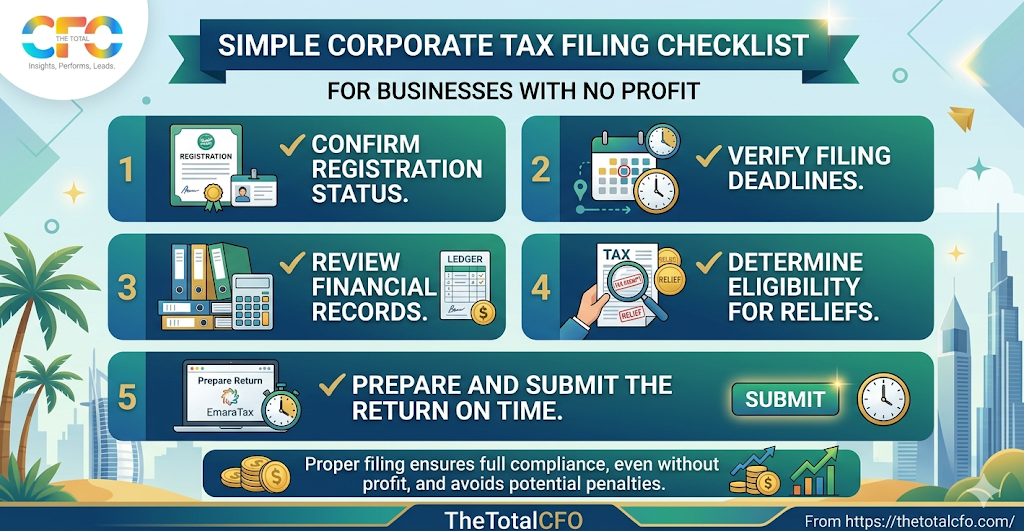
No profit ≠ no corporate tax return requirement.
The reason why is because even if at the end of it all, there is no Corporate Tax liability, you might be required to register, keep records, and file the Corporate Tax Return.
Differentiating between profit and compliance will help you avoid any legal problems as well as keep your reputation with the FTA intact. Through timely assessment and record-keeping of your responsibilities, your business can always maintain compliance irrespective of whether there is any tax liability.
Need professional advice on handling your Corporate Tax obligations? Consulting a corporate tax consultant in Dubai can help businesses understand their filing responsibilities, avoid penalties, and remain compliant with FTA regulations.
Book a free consultation with our Corporate Tax experts for personalized guidance for your business.
Yes. If your business is registered for UAE Corporate Tax, you are generally required to file a Corporate Tax Return even if your company made no profit or incurred losses during the financial year.
No. Zero tax liability and filing obligations are two separate concepts. A business may not owe any Corporate Tax, but it may still be required to submit its Corporate Tax Return and comply with all reporting requirements.
The Federal Tax Authority (FTA) requires businesses to file returns to verify their financial position, assess whether any tax liability exists, and ensure ongoing compliance with UAE Corporate Tax regulations.
Failure to file may result in administrative penalties, increased compliance scrutiny, and potential difficulties in future regulatory, financing, or restructuring matters.
Businesses should maintain complete financial records, including income and expense statements, invoices, contracts, bank statements, accounting reports, and other supporting documents to substantiate the information reported in the tax return.
Yes. Startups and newly established companies that are operating at a loss may still have Corporate Tax compliance obligations, including registration, record-keeping, and filing of Corporate Tax Returns, depending on their circumstances.
With over 18 years of experience across MIS, management control, and senior finance roles, Archana Mundhra has strengthened financial systems for companies in manufacturing, trading, services, and technology. As CFO Partner at The Total CFO Management Consultancy and Director at A2R Info Solutions Pvt. Ltd., she specialises in reporting frameworks, budgeting, process optimisation, and operational discipline. She believes finance is about understanding the story behind the numbers and using it to drive better decisions.


With over 25 years in Dubai and nearly 30 years as a Chartered and Management Accountant, Hemant has extensive experience across manufacturing, services and technology sectors. He has worked with major corporate groups including Al Tayer, Saif Al Ghurair, Dhabi, and Aditya Birla. Hemant specializes in profitability and cost management, debt restructuring, contract management, and regulatory compliance, having generated approximately USD 47.5 million in savings and profit growth. A confident public speaker and Distinguished Communicator, he lives by the quote: “You get what you reward for. If you want ants to come, you put sugar on the floor” (Charlie Munger), embodying his belief that “Profit has its own intelligence.”

Archana Mundhra is a qualified Chartered Accountant with over 15 years of experience in multinational corporations. Her proficiency lies in financial planning and business intelligence. Her deep financial understanding and profound analytical skills empower her to assist management in realizing their objectives effectively.

Rinkle Jain is a qualified Chartered Accountant and Fellow Member of the Institute of Chartered Accountant of India. A results-driven Chartered Accountant with a distinguished career marked by proficiency in management, financial planning, and catalyzing overall company development.Demonstrates a unique blend of financial acumen, strategic insight, and leadership prowess, contributing significantly to organizational success.
test