2026-09-09

Are you planning your family wealth structure in the UAE? There’s something you should know about the difference between them, which might have procedural consequences for you.
Article 17 of the CT Law treats Foundations and Trusts alike as far as corporate tax is concerned. Both may be considered Family Foundations and thus receive equal treatment when it comes to taxes provided that they meet five criteria. But this is only as far as similarity goes. In terms of their legal nature, Foundations and Trusts are two different things and their difference determines what you need to do to access the tax benefit.
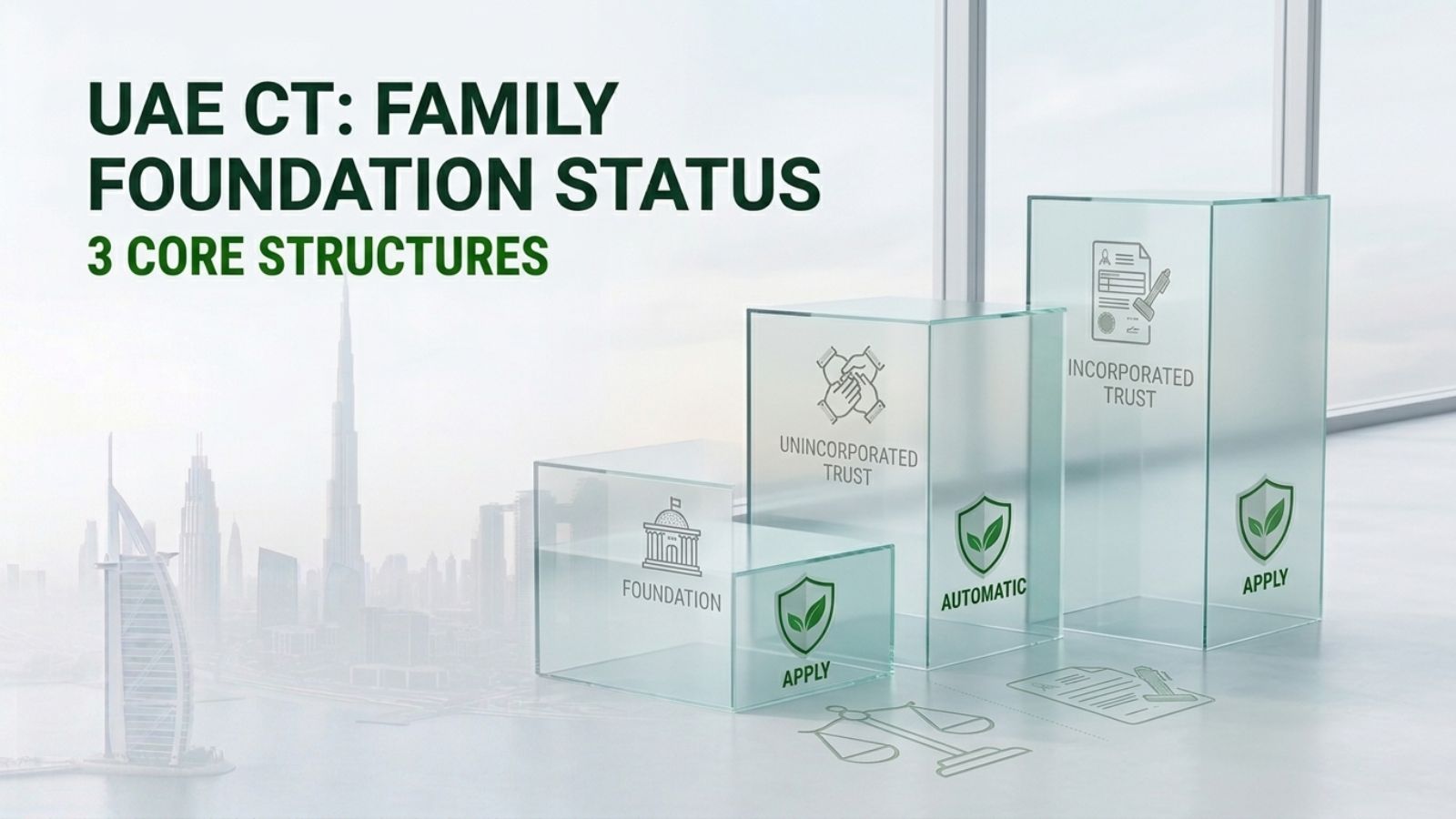
A Foundation registered under DIFC or ADGM legislation is a separate legal entity, which means that it is a distinct legal entity from the founder and the beneficiaries. As a consequence of this, it cannot be automatically considered a transparent entity for CT purposes. The application for such status should be filed to the Federal Tax Authority (FTA).
Unlike a Foundation, an unincorporated trust is not a separate legal entity. It is regarded as a relationship between the trustee and the beneficiaries. Because of this, it is automatically treated as transparent under UAE CT Law, and any application to the FTA isn’t required.
Incorporated Trusts, introduced under Federal Law 31/2023, occupy a middle ground. Like Foundations, Incorporated Trusts have their own legal identity, but they need to apply to the FTA in order to get the transparent status.They cannot assume transparency by default.
The tax outcome for all three structures may ultimately be the same; they can all qualify as Family Foundations under Article 17 and benefit from CT transparency. However, the procedural burden varies significantly for each structure:
| Structure | Legal Personality | CT Transparency |
| DIFC / ADGM Foundation | Yes — separate entity | Must apply to FTA |
| Unincorporated Trust | No | Automatic |
| Incorporated Trust (FL 31/2023) | Yes — separate entity | Must apply to FTA |
In case you miss your FTA application where it’s required, your structure may not be treated as transparent, even if it otherwise qualifies under the law.
In determining the appropriate way to structure family wealth in the UAE, the decision between setting up either a Foundation or Trust is not only one that involves the choice of entity type but also carries important procedural considerations within the CT regime. It would be wise to consider the following questions first:
Getting this right from the outset can prevent costly compliance gaps down the road.
Understanding the Corporate Tax Laws of the UAE becomes quite challenging when family wealth structures and succession planning become involved.
At The Total CFO, our experienced Corporate Tax Consultants help individuals, family offices, and businesses structure Foundations and Trusts in line with UAE Corporate Tax regulations.
We guide our clients across the UAE with ensuring that the right structure and all the procedural aspects are considered in compliance with the Corporate Tax Laws of the UAE.
Unsure whether your Foundation or Trust is set up for CT compliance, or you’re in the process of planning a family wealth structure? We’d be ready to assist you. Book a free consultation with our tax experts and simplify your family wealth structuring process.
A Foundation is a separate legal entity, whereas an Unincorporated Trust is a legal arrangement between trustees and beneficiaries. This distinction affects how each structure obtains Corporate Tax transparency status.
Under Article 17 of the UAE Corporate Tax Law, both structures can receive similar tax treatment as Family Foundations if they satisfy the prescribed qualifying conditions.
Yes. Since Foundations have separate legal personalities, they must submit an application to the Federal Tax Authority to be treated as tax transparent entities.
No. Unincorporated Trusts are automatically considered transparent for UAE Corporate Tax purposes and generally do not require a separate FTA application.
Failure to submit the required application may result in the entity not being treated as tax transparent, potentially leading to unexpected Corporate Tax obligations.
Professional guidance from a Corporate Tax Consultant helps ensure that the structure meets Article 17 requirements, complies with procedural obligations, and aligns with long-term succession and wealth preservation objectives.
With over 25 years in Dubai and nearly 30 years as a Chartered and Management Accountant, Hemant has extensive experience across manufacturing, services and technology sectors. He has worked with major corporate groups including Al Tayer, Saif Al Ghurair, Dhabi, and Aditya Birla. Hemant specializes in profitability and cost management, debt restructuring, contract management, and regulatory compliance, having generated approximately USD 47.5 million in savings and profit growth. A confident public speaker and Distinguished Communicator, he lives by the quote: “You get what you reward for. If you want ants to come, you put sugar on the floor” (Charlie Munger), embodying his belief that “Profit has its own intelligence.”


With over 25 years in Dubai and nearly 30 years as a Chartered and Management Accountant, Hemant has extensive experience across manufacturing, services and technology sectors. He has worked with major corporate groups including Al Tayer, Saif Al Ghurair, Dhabi, and Aditya Birla. Hemant specializes in profitability and cost management, debt restructuring, contract management, and regulatory compliance, having generated approximately USD 47.5 million in savings and profit growth. A confident public speaker and Distinguished Communicator, he lives by the quote: “You get what you reward for. If you want ants to come, you put sugar on the floor” (Charlie Munger), embodying his belief that “Profit has its own intelligence.”

Archana Mundhra is a qualified Chartered Accountant with over 15 years of experience in multinational corporations. Her proficiency lies in financial planning and business intelligence. Her deep financial understanding and profound analytical skills empower her to assist management in realizing their objectives effectively.

Rinkle Jain is a qualified Chartered Accountant and Fellow Member of the Institute of Chartered Accountant of India. A results-driven Chartered Accountant with a distinguished career marked by proficiency in management, financial planning, and catalyzing overall company development.Demonstrates a unique blend of financial acumen, strategic insight, and leadership prowess, contributing significantly to organizational success.
test