
2026-08-21


While filing corporate tax has been made mandatory since 2023, many companies in the UAE take corporate tax delays as an administrative issue rather than a serious situation. However, businesses that don’t comply with the corporate tax filing deadline may face multiple (and potentially costly) penalties due to their noncompliance.
Since the introduction of corporate tax, the FTA has placed greater emphasis on enforcing compliance to the new tax regime than awareness campaigns and disseminating information pertaining to corporate taxation, and as a result, the penalties for noncompliance have increased significantly starting in 2026.
This article aims to help you understand the consequences of missing the corporate tax registration deadline in the UAE, including what kinds of penalties await those who missed the deadline, possible ways to have these penalties waived, misconceptions, and the actions businesses should take immediately upon becoming aware of their mistake to minimize additional risks.
Before any considerations of dealing with penalties, you must first determine whether any of the deadlines for corporate tax filing apply to your business. There are multiple deadlines for different types of businesses and failing to meet one deadline does not equate to failing to meet another deadline.
If a company was just recently incorporated, it must register for corporate tax within three months of incorporation. For companies that operate on a calendar year (e.g., those which operate from January to December), their 2025 tax filing deadline will typically be established as 30 September 2026.
Natural persons or freelancers who participate in business transactions may also fit within this process, however the deadline for registration under the system will typically be established by 31 March 2026, provided that turnover requirements are met.
For companies with a custom fiscal year, the way they calculate their tax obligations is going to be different than for companies that have a June or December financial year-end. In this case, the tax filing obligations for companies with a custom/fiscal year will be due nine months after the end of their fiscal year, unlike companies that must file by September, which will only have an obligation to file on or before 30 September each year.
The first consequence of non-compliance with UAE corporate tax registration is the issuance of a mandatory fixed administrative fine of AED 10,000. Unlike other penalties, it is not determined based on the number of days of overdue or tax amount to be paid, but set regardless of the business size, turnover, or its profits.
It’s worth noting that the penalty may apply even if your business has no corporate tax liability at all. Although many companies believe that having no taxable profit means avoiding the risk, the Federal Tax Authority considers the two issues unrelated and separate.
The penalty may also be applicable even in case the business was not informed about the deadline. Starting with 2026, the authority will be increasingly inclined towards determining eligibility for registration, rather than the ability of the taxpayer to comply with its regulations.
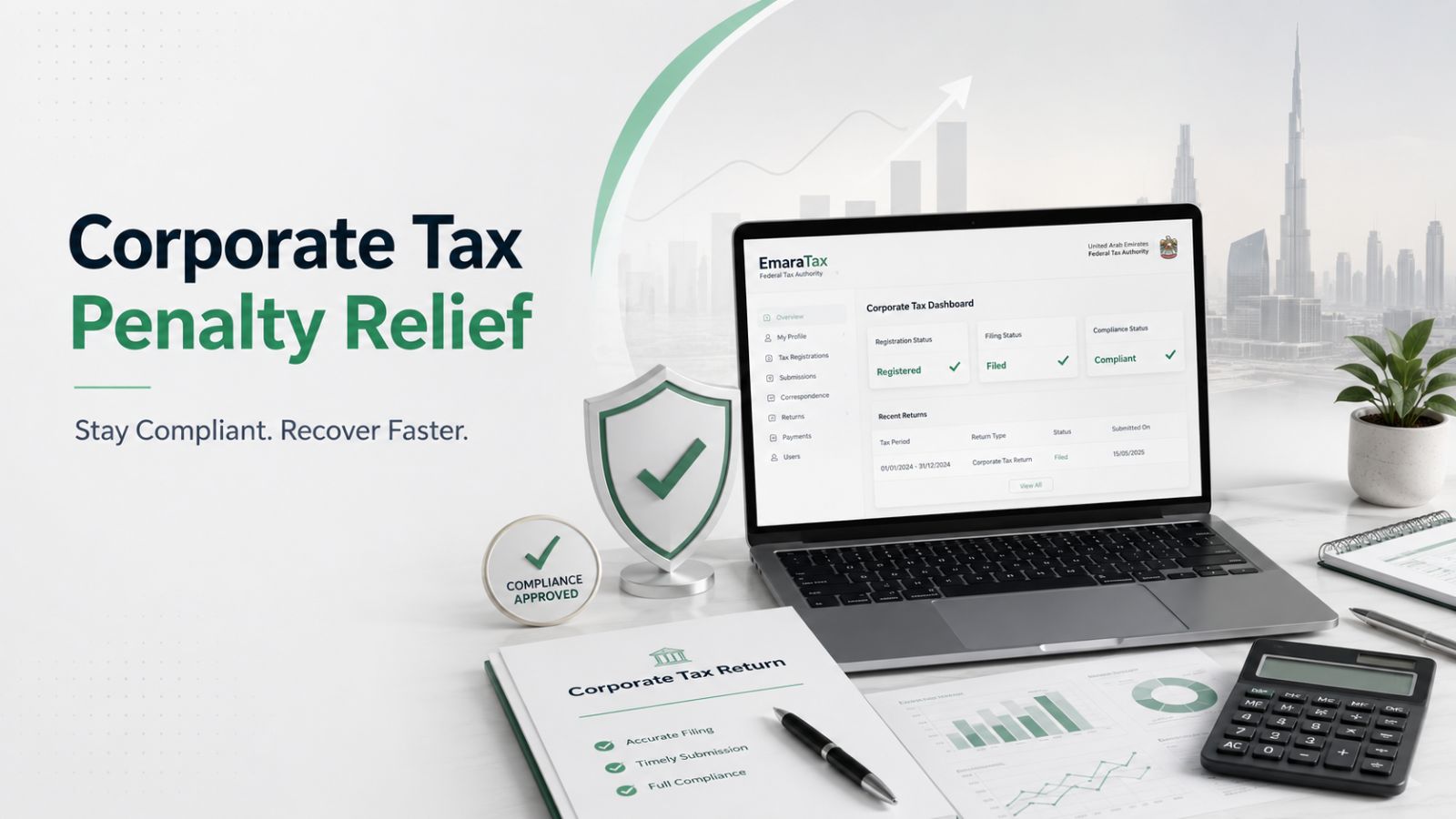
The notification of fines is usually done through the EmaraTax portal, which is directly related to the taxpayer’s account. Although the amount of AED 10,000 for the fine is usually constant without accruing further, there will be more problems associated with failing to act on the issue.
In most cases, the penalty notification is issued through the EmaraTax portal and linked directly to the business’s tax account. While the AED 10,000 fine itself generally remains fixed rather than compounding over time, delayed action can still create additional compliance risks, filing complications, and future scrutiny.
The AED 10,000 penalty is often only part of the issue. In 2026, delayed registration or unresolved discrepancies can create wider compliance risks that affect banking, audits, contracts, and business reputation.
Registration delay or absence of it can put the company at a non-compliance flag in their FTA file, which means there will be a chance of further inspection by FTA in the future. At present, FTA has been more concerned about the companies with incompletely registered, non-filing, and non-compliance records.
Compliance for corporate taxes has become an essential component of business relations. UAE banks are increasingly cross-checking tax status during account reviews and financing assessments, while many government tenders and contracts now require proof of tax compliance.
For businesses working with multinational clients, compliance issues can also create reputational concerns during due diligence reviews. Free Zone businesses face additional exposure, as poor compliance may risk the loss of Qualifying Free Zone Person (QFZP) status and the associated 0% tax benefit.
To ease the transition into the UAE corporate tax regime, the FTA introduced limited relief initiatives for certain businesses that missed their registration deadlines. In specific cases, businesses may qualify for a waiver of the AED 10,000 late registration penalty.
The key condition is typically that the business must file its first corporate tax return or annual declaration within 7 months from the end of its first tax period. This relief was primarily designed for businesses that registered late but moved quickly to complete their remaining compliance obligations.
In practice, the waiver tends to help businesses that are otherwise compliant and able to file accurately within the shortened timeline. It is far less useful for businesses that still have unresolved accounting issues, incomplete records, or ongoing registration delays.
Whether the waiver remains available in 2026 depends on the FTA’s current relief framework and announcements at the time of filing. Businesses should not assume that transitional relief measures will continue indefinitely.
It is also important to understand that waivers are discretionary. They are not automatic, guaranteed, or something businesses should rely on as part of their compliance strategy.
If your business has missed a corporate tax registration deadline, the most important step is to act immediately. Delaying further only increases compliance risks and makes future filings more difficult to manage.
Start by identifying exactly which deadline was missed and what obligations currently apply to your business. Registration deadlines, filing deadlines, and annual declaration requirements can differ depending on your entity type and financial year structure.
Next, complete your registration through EmaraTax as soon as possible, even if the deadline has already passed. Late registration is still significantly better than remaining completely unregistered.
Businesses should also assess whether they may qualify for an FTA penalty waiver and begin preparing the supporting documentation needed for any relief application. At the same time, it is important to organise accounting records, update compliance calendars, and prepare for upcoming filing obligations to avoid repeated issues.
You can also consider professional guidance from corporate tax consultants in Dubai before submitting late registrations or corrective filings. A rushed registration with incorrect information can create additional complications and delays.
Preventing any future corporate tax penalties begins with implementing a proper corporate tax compliance system based on the specific structure of the business and financial period.
It’s important to ensure that a certain responsible person or department within a corporation takes the initiative to fulfill all compliance-related requirements and does not leave anything to chance. The appointment of reminders 90, 60, and 30 days prior to each FTA deadline can significantly mitigate last-minute pressure and filing errors.
Also make sure to adjust bookkeeping procedures to enable effective and timely submission of the relevant documents at the corporate level. For many businesses, outsourcing corporate tax compliance to a specialist firm can help reduce operational risk and improve accuracy.
Another major consideration in 2026 is the UAE’s phased rollout of e-Invoicing requirements, which will add an additional layer of compliance and reporting obligations for businesses.
Missing a corporate tax deadline is serious, but it is not the end of the road. What matters most is how quickly a business responds afterward. Delays become costly when they are left unaddressed, not when they are corrected promptly.
Businesses that recover smoothly are typically the ones that take immediate action, correct their registration or filing position, and seek professional support early rather than trying to navigate the process alone.
It’s better to take a proactive approach with the Federal Tax Authority (FTA) rather than waiting for enforcement action or penalties to escalate. Early correction and transparent compliance efforts generally lead to fewer complications in the long run.
Missed your corporate tax registration deadline or are unsure about your current compliance status? Our team of seasoned accountants at The Total CFO can help you assess your situation, complete registration correctly, and explore potential penalty relief options where applicable. Book a free consultation today.
If you miss the corporate tax registration deadline, the UAE Federal Tax Authority (FTA) may impose an administrative penalty of AED 10,000. The fine applies even if your business has not generated taxable profits or owes no corporate tax.
Most businesses operating in the UAE are required to assess their eligibility for corporate tax registration, including mainland companies, certain Free Zone entities, and some natural persons or freelancers meeting the turnover threshold.
In certain cases, the FTA may allow a penalty waiver if the business files its first corporate tax return or annual declaration within the required relief timeframe. However, approval is discretionary and depends on the FTA’s latest rules and the business’s compliance status.
Yes. Delayed registration may create compliance risks that can impact banking relationships, government tenders, financing applications, audits, and business reputation. Free Zone companies may also risk losing Qualifying Free Zone Person (QFZP) benefits if compliance issues remain unresolved.
Businesses should register through the EmaraTax portal as soon as possible, review their compliance obligations, organise financial records, and assess whether they qualify for any penalty relief. Seeking professional tax advice can also help avoid further filing errors or complications.
Businesses can reduce compliance risks by maintaining accurate accounting records, setting internal deadline reminders, assigning responsibility for tax compliance, and working with experienced corporate tax consultants to manage registrations and filings on time.
With over 18 years of experience across MIS, management control, and senior finance roles, Archana Mundhra has strengthened financial systems for companies in manufacturing, trading, services, and technology. As CFO Partner at The Total CFO Management Consultancy and Director at A2R Info Solutions Pvt. Ltd., she specialises in reporting frameworks, budgeting, process optimisation, and operational discipline. She believes finance is about understanding the story behind the numbers and using it to drive better decisions.


With over 25 years in Dubai and nearly 30 years as a Chartered and Management Accountant, Hemant has extensive experience across manufacturing, services and technology sectors. He has worked with major corporate groups including Al Tayer, Saif Al Ghurair, Dhabi, and Aditya Birla. Hemant specializes in profitability and cost management, debt restructuring, contract management, and regulatory compliance, having generated approximately USD 47.5 million in savings and profit growth. A confident public speaker and Distinguished Communicator, he lives by the quote: “You get what you reward for. If you want ants to come, you put sugar on the floor” (Charlie Munger), embodying his belief that “Profit has its own intelligence.”

Archana Mundhra is a qualified Chartered Accountant with over 15 years of experience in multinational corporations. Her proficiency lies in financial planning and business intelligence. Her deep financial understanding and profound analytical skills empower her to assist management in realizing their objectives effectively.

Rinkle Jain is a qualified Chartered Accountant and Fellow Member of the Institute of Chartered Accountant of India. A results-driven Chartered Accountant with a distinguished career marked by proficiency in management, financial planning, and catalyzing overall company development.Demonstrates a unique blend of financial acumen, strategic insight, and leadership prowess, contributing significantly to organizational success.
test