
2026-08-26

For years, the UAE has been seen as a prime destination for new businesses offering new possibilities in growth, a supportive business tax environment, a strategic address, and so on.
But a coveted business location like the UAE doesn’t come without tax responsibilities and financial requirements. Among these, VAT registration represents an important step in maintaining compliance and preventing penalties that could cost your business time and money.
With that being said, the process isn’t the same for all companies, and the registration requirements can look different. Thus, navigating it with a tax consultant early on can make your VAT journey easier and much more compliant.
This guide will help you learn about VAT registration for your newly established company in the UAE.
VAT is a consumption tax charged on most of the goods and services in the UAE. Rolled out in 2018, the standard VAT rate now stands at 5%. All registered businesses are responsible for collecting VAT from customers and remitting it to the Federal Tax Authority (FTA).
Upon registration, you will get a Tax Registration Number (TRN) for your business, which you need to include in all of your tax invoices and VAT documents.
Not all businesses will have an automatic requirement for registration. The requirements vary based on your taxable turnover.
The requirement for VAT registration would apply to those businesses:
Voluntary registration can be advantageous for growing businesses as it gives them an opportunity of reclaiming eligible input VAT on business expenses. It also helps them in presenting a more established image to clients and suppliers, increasing their credibility.
There may also be a possibility of voluntary registration in case of:
It is a common misconception that a firm operating within UAE Free Zones doesn’t need VAT registration due to exemption status. However, firms operating within Free Zones might still be eligible for VAT registration based on various criteria including business operations and turnovers.
Therefore, whether your firm operates within designated or non-designated Free Zones, it should consider its VAT obligations based on its business model.
Having all the documents sorted out prior to applying will help to make the process faster. In most instances, you will require:
Additional documents may be required based on the structure or operation of your business.
First, create an EmaraTax account, the UAE’s official tax portal. Ensure that your account is verified using the credentials provided.
Fill your tax profile with the legal information such as company name, license details, contact details and authorised personnels’ details. Make sure the data is in conformity with your company details.
Navigate to the VAT registration feature and initiate your application process. The portal will help you fill each section.
In the following fields, provide the following information:
Provide information about your taxable turnover, expected income and importing/exporting details. This information will be used to determine if you have the right to register for VAT.
Upload all required documents in readable format. Make sure that:
Thoroughly check each part of your application form before submitting it. Even slight mistakes regarding the details of the firm or its finances may cause you further inquiries from the FTA.
Upon the completion of the submission process, an application number will be given to you to track your progress through the application process.
Upon approval of your application, the FTA will issue you a Tax Registration Number (TRN) and a VAT Registration Certificate.
VAT registration doesn’t mark the end, but the start of the whole process of fulfilling your VAT obligations as a company. After registering, you’ll be required to fulfill these:
A majority of the errors and delays in registrations can be avoided by being well-prepared for them. These are some of the typical errors:
VAT registration is an integral step in the growth of any business in the UAE. Regardless of whether registration is compulsory or optional, following the proper process ensures that your firm remains compliant and minimizes the risk of penalties imposed by the Federal Tax Authority (FTA). Seeking guidance from experienced VAT Consultants in Dubai can help businesses navigate registration requirements, maintain compliance, and avoid costly errors throughout the VAT lifecycle.
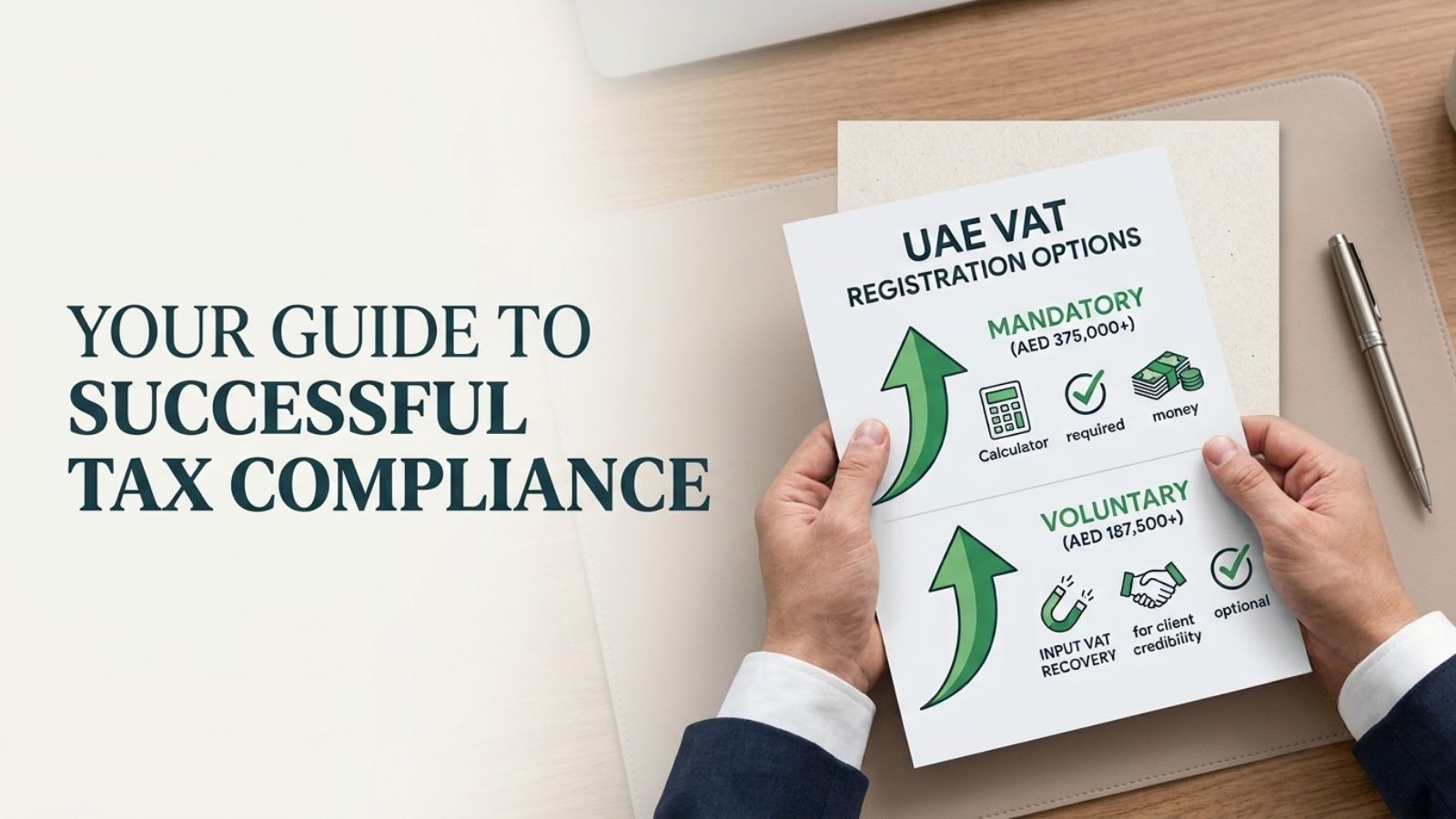
VAT registration becomes mandatory if your business’s taxable supplies exceed AED 375,000 in the previous 12 months or are expected to exceed this threshold within the next 30 days.
Yes. Businesses can voluntarily register if their taxable supplies or taxable expenses exceed AED 187,500, even if they have not reached the mandatory threshold.
The processing time may vary depending on the completeness of the application and FTA review requirements. Generally, businesses can expect approval within a few business days to a few weeks.
Yes, in certain cases. Operating in a Free Zone does not automatically exempt a company from VAT obligations. Registration requirements depend on the company’s activities, transactions, and taxable turnover.
Commonly required documents include a trade license, certificate of incorporation, MOA, passport copies of owners, Emirates IDs (if applicable), banking details, and turnover information.
After registration, businesses must charge VAT where applicable, issue VAT-compliant invoices, maintain accounting records, file VAT returns on time, and retain supporting documents for FTA audits.
With over 25 years in Dubai and nearly 30 years as a Chartered and Management Accountant, Hemant has extensive experience across manufacturing, services and technology sectors. He has worked with major corporate groups including Al Tayer, Saif Al Ghurair, Dhabi, and Aditya Birla. Hemant specializes in profitability and cost management, debt restructuring, contract management, and regulatory compliance, having generated approximately USD 47.5 million in savings and profit growth. A confident public speaker and Distinguished Communicator, he lives by the quote: “You get what you reward for. If you want ants to come, you put sugar on the floor” (Charlie Munger), embodying his belief that “Profit has its own intelligence.”


With over 25 years in Dubai and nearly 30 years as a Chartered and Management Accountant, Hemant has extensive experience across manufacturing, services and technology sectors. He has worked with major corporate groups including Al Tayer, Saif Al Ghurair, Dhabi, and Aditya Birla. Hemant specializes in profitability and cost management, debt restructuring, contract management, and regulatory compliance, having generated approximately USD 47.5 million in savings and profit growth. A confident public speaker and Distinguished Communicator, he lives by the quote: “You get what you reward for. If you want ants to come, you put sugar on the floor” (Charlie Munger), embodying his belief that “Profit has its own intelligence.”

Archana Mundhra is a qualified Chartered Accountant with over 15 years of experience in multinational corporations. Her proficiency lies in financial planning and business intelligence. Her deep financial understanding and profound analytical skills empower her to assist management in realizing their objectives effectively.

Rinkle Jain is a qualified Chartered Accountant and Fellow Member of the Institute of Chartered Accountant of India. A results-driven Chartered Accountant with a distinguished career marked by proficiency in management, financial planning, and catalyzing overall company development.Demonstrates a unique blend of financial acumen, strategic insight, and leadership prowess, contributing significantly to organizational success.
test