2026-08-26

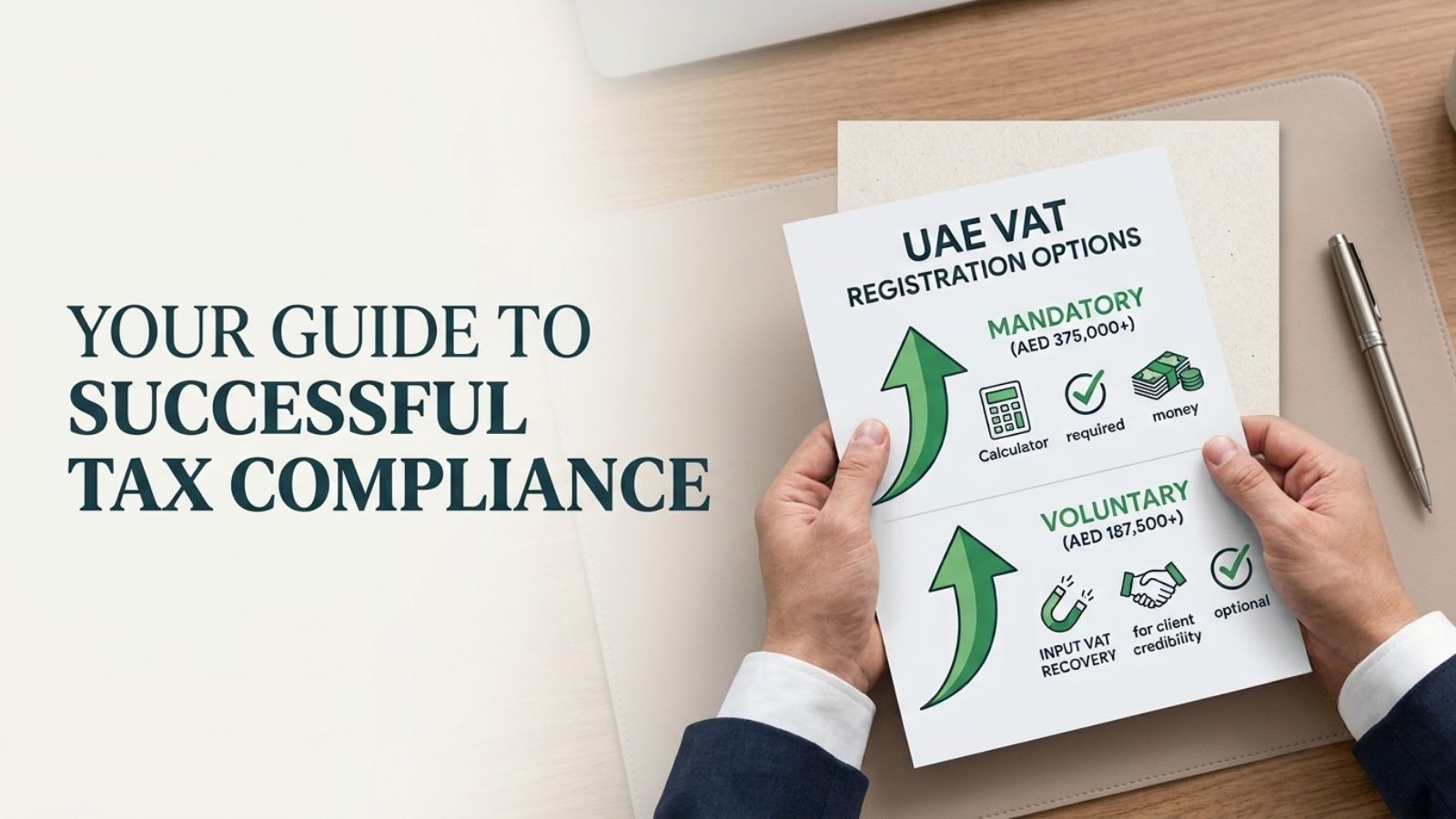
If you’re about to establish or grow your business in the UAE, then the first question to come to your mind will be whether your business requires you to register for VAT or not. Even though some businesses are mandatorily required to register for VAT, there are many other businesses that have an opportunity to register voluntarily.
Differentiating between both types of VAT registration is very important because it’s not just about being compliant with the FTA but is also about making sound financial decisions. In this article, we will discuss the difference between mandatory VAT registration and voluntary VAT registration.
VAT is a 5% consumption tax levied on all products and services offered in the UAE. Companies that are eligible according to the registration criteria set out by the FTA should register for VAT, collect taxes from clients if necessary, submit VAT returns, and keep appropriate records.
Mandatory vs. Voluntary registration is mainly based on the taxable income of your company.
The need for VAT registration arises from those organizations which exceed the threshold level fixed by the FTA.
You’re supposed to register for VAT, if:
Note: Upon reaching either of the two thresholds above, there is no choice but to register for VAT. Delay in registration might cause further complications, such as late registration penalty of upto AED 10,000 and late return filing of upto AED 1,000 for the first offense( and AED 2,000 for repeated delays within a 24-month period).
It is possible to choose to register for VAT if the business has not yet reached the compulsory threshold and qualifies under a lower threshold requirement.
You can register voluntarily once your total taxable supplies or total taxable expenses exceed a threshold of AED 187,500.
Although the process of registration is voluntary at this level, many businesses prefer to register themselves as this offers them several business advantages.
| Mandatory Registration | Voluntary Registration |
| Required by law | Optional |
| Applies after taxable supplies exceed AED 375,000 | Available once taxable supplies or expenses exceed AED 187,500 |
| Failure to register may result in penalties | No penalty for choosing not to register (if below the mandatory threshold) |
| Businesses must comply with all VAT filing requirements | Registered businesses have the same VAT compliance obligations |
While the registration trigger differs, both types of registration carry the same ongoing responsibilities once approved.
The right answer depends on your current revenue and future business plans.
You should mandatorily register if:
You may consider voluntary registration if:
However, many businesses feel that it is better to wait until compulsory registration applies. Voluntary registration, however, does come with its own set of strategic gains.
Some of them include:
Voluntary registration can provide long-term operational benefits to startups and growing SMEs.
This is regardless of whether you are registering on a voluntary basis or on a mandatory one as your responsibilities will still be the same.
If you are registered you will be expected to:
Voluntary registration does not relieve you of any of the above duties.
VAT registration can be a straightforward process, yet businesses often make avoidable mistakes that can lead to delays or compliance issues.
Examples of such errors include:
Deciding on whether to opt for mandatory or voluntary VAT registration isn’t much about choice, but about knowing where your business stands currently and what its future holds.
When your taxable supplies are above AED 375,000, then it is compulsory for you to register for VAT. When your taxable supplies have exceeded AED 187,500, voluntary registration will bring in numerous advantages for you including recovery of input VAT, improved reputation and so forth.
Want to navigate tax requirements with professional expertise? Our vat consultants in Dubai can help you with the complexities of VAT registration while helping you stay compliant. Book a free VAT consultation with our tax experts to get a VAT registration roadmap.
Businesses must register for VAT if their taxable supplies exceed AED 375,000 during the previous 12 months or are expected to exceed this threshold within the next 30 days.
Businesses can voluntarily register for VAT once their taxable supplies or taxable expenses exceed AED 187,500.
No. Businesses below the mandatory threshold are not penalized for choosing not to register voluntarily.
Yes. Startups and newly established businesses can voluntarily register if they meet the AED 187,500 threshold through taxable expenses or supplies, enabling them to recover eligible input VAT.
Key benefits include:
Recovery of input VAT on eligible expenses
Enhanced credibility with clients and suppliers
Better preparedness for future growth and compliance requirements
Yes. Being located in a Free Zone does not automatically exempt a business from VAT registration requirements. Eligibility depends on the nature of activities and taxable supplies generated by the business.
With over 18 years of experience across MIS, management control, and senior finance roles, Archana Mundhra has strengthened financial systems for companies in manufacturing, trading, services, and technology. As CFO Partner at The Total CFO Management Consultancy and Director at A2R Info Solutions Pvt. Ltd., she specialises in reporting frameworks, budgeting, process optimisation, and operational discipline. She believes finance is about understanding the story behind the numbers and using it to drive better decisions.


With over 25 years in Dubai and nearly 30 years as a Chartered and Management Accountant, Hemant has extensive experience across manufacturing, services and technology sectors. He has worked with major corporate groups including Al Tayer, Saif Al Ghurair, Dhabi, and Aditya Birla. Hemant specializes in profitability and cost management, debt restructuring, contract management, and regulatory compliance, having generated approximately USD 47.5 million in savings and profit growth. A confident public speaker and Distinguished Communicator, he lives by the quote: “You get what you reward for. If you want ants to come, you put sugar on the floor” (Charlie Munger), embodying his belief that “Profit has its own intelligence.”
Archana Mundhra is a qualified Chartered Accountant with over 15 years of experience in multinational corporations. Her proficiency lies in financial planning and business intelligence. Her deep financial understanding and profound analytical skills empower her to assist management in realizing their objectives effectively.

Rinkle Jain is a qualified Chartered Accountant and Fellow Member of the Institute of Chartered Accountant of India. A results-driven Chartered Accountant with a distinguished career marked by proficiency in management, financial planning, and catalyzing overall company development.Demonstrates a unique blend of financial acumen, strategic insight, and leadership prowess, contributing significantly to organizational success.
test